Build vs Buy: the agentic-AI for support decision

For 90% of enterprise CS use cases, buying agentic AI wins on TCO and time-to-value. The 10% where build is right, and how to tell.

For 90% of enterprise use cases, buying wins on TCO and time-to-value. Here's the framework — and the 10% where build is the right call.

Why build vs buy AI agent matters

Every enterprise running AI for support eventually faces the same decision: stand up an internal team to build the agentic stack, or contract with a specialized vendor. The right answer is not the same for every company. It is the same for the vast majority of companies.

The 2025-2026 research is unambiguous on the distribution. For 90% of enterprise use cases, buying wins. It compresses time-to-value from 18 months to weeks. It eliminates the 40-80% TCO surprise that custom builds carry. It moves the optimization labor — the actual work — off the customer's roadmap.

The 10% where build is the right call is real. This piece is for both sides — the framework that distinguishes them, and the honest economic comparison underneath.

What “build” actually costs in 2026

The line-item cost of building an enterprise agentic-AI system in 2026 is well-published: $15,000 for a focused single-task agent, up to $400,000+ for an enterprise-grade multi-agent system with compliance, custom integrations, and orchestration. Mid-market enterprise builds typically sit in the $40,000-$150,000 range for the first deployment.

That is the headline. The body of the bill arrives later. Across the published 2026 build-vs-buy analyses, most enterprise AI agent budgets underestimate the true total cost of ownership by 40-60%. Infrastructure, ongoing LLM usage, integration complexity, maintenance, and governance add 40-80% to the first-year TCO.

Model API costs are a smaller share than buyers expect — only 8-15% of total build cost for most enterprise agentic systems. The cost driver is not the model. It is the human-intensive work around the model: governance, quality assurance, security oversight, and adaptation to evolving requirements.

Why buying wins for 90% of enterprises

The success-rate data is consistent: specialized vendor partnerships succeed at ~67%, while internal builds succeed at one-third that rate. The reason is not engineering capability. The reason is the operational discipline that surrounds the engineering.

A specialized vendor has run hundreds of deployments. The KB-gap-closure playbook is a checklist, not a research project. The confidence-threshold tuning is automated. The escalation logic has been A/B tested across thousands of conversations. The compliance posture is already filed.

An internal team has run zero deployments. Every playbook is the first version. Every tuning loop is discovery work. Every compliance question becomes a stage of the build.

Time-to-value reflects this. The published build path averages 18 months to first measurable outcome. The buy path averages weeks. The math compounds: 17 months of vendor production outcomes vs. 17 months of internal build runway is the single largest line item in the comparison — and it rarely appears in the build-vs-buy spreadsheet because the spreadsheet treats both paths as starting on day zero.

The numbers across the published 2026 research

Cost, time, and success-rate comparisons.

The build-vs-buy decision is unusually well-instrumented in the 2026 research. The numbers below come from third-party TCO analyses and the cited research bodies.

The line that does the work in this table is “time-to-first-value.” A 17-month head start on vendor-delivered outcomes is, in practice, the entire argument. Everything else compounds inside that gap.

The 10% where build is the right call

Build wins when one or more of four conditions are true:

The use case is a competitive moat. If your AI for support is itself the product (a customer-facing AI assistant that defines your offer, not your internal support function), the case for build strengthens.The data cannot leave your infrastructure. Regulated workloads — sovereign-data, classified, or specific regulatory-residency requirements — may rule out vendor-hosted options. (See the related pillar on hybrid LLM deployments.)You have run the operational discipline before. If your team has stood up and run production ML/AI systems at scale through several iterations of model drift, build cost compresses. This is the rarest of the four conditions.The unit economics favor it at your scale. Build-vs-buy crosses over only at very large transaction volumes where the vendor's per-resolution pricing compounds beyond the build TCO. The crossover point is vendor-specific and worth modeling honestly.

None of these are about preference or “control.” They are observable criteria. If fewer than two are true, the math favors buy.

The four questions to ask any vendor

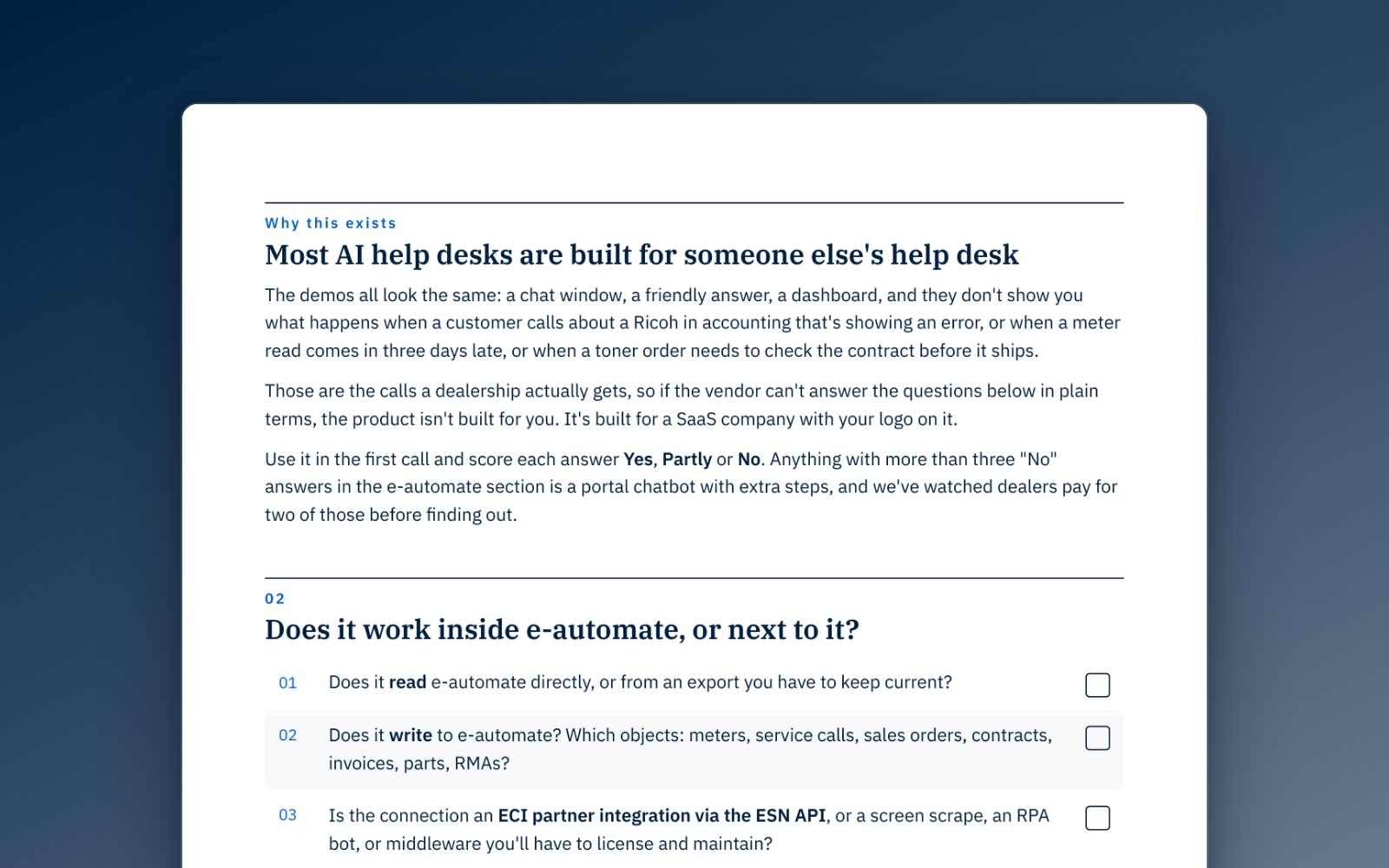
Use these on the next vendor call. They reveal the structure of the deal — not just the feature set.

If the AI is the product, build may be necessary. If the AI supports the product, buy almost always wins.

If yes, the buy path is open. If no, the comparison narrows to on-prem-capable vendors and self-hosted builds — still a comparison, just a smaller field.

The honest answer is rarely yes. Build TCO assumes this experience exists; if it doesn't, the TCO underestimation is larger than the 40-60% baseline.

This is the question that tilts decisions. If a failed pilot costs you a competitive cycle, a buy-path 67% success rate dominates a build-path 22% rate at almost any headline cost difference.

The build-vs-buy decision is rarely as close as it looks in the headline cost comparison. Once the TCO surprise (40-80% above first-year), the success-rate gap (3x vendor advantage), and the time-to-first-value compression (18 months to weeks) are in the model, buy wins for 90% of enterprise support use cases.

The 10% where build wins is real, and the four conditions above are how to identify it honestly. If fewer than two are true, the buy path is the safer bet.

Auralis is the buy path for the support use case — outcome-contracted, vendor-owned optimization, weeks to first-value, full transparency on the cohort outcomes. The next conversation is the four-question framework against your specific environment.

Auralis vs Decagon— where Auralis lands when AOPs are too much overheadAuralis vs Intercom Fin— the native-helpdesk-AI archetype, head-to-headAuralis vs Sierra— for teams who want the agent without the platform taxKnowledge Center— where the KB-gap closure loop actually runsAisera — “Build vs Buy AI Agents: Complete Guide to Adopt AI (2026).”Searchunify — “AI Agent Costs 2026: Complete TCO Guide | Build vs Buy.”Hyperion Consulting — “Build vs Buy AI: The Total Cost of Ownership Framework.”Xenoss — “Total cost of ownership for enterprise AI: Hidden costs.”Fortune — MIT GenAI failure research, August 2025. Source for the 22% vs 67% success-rate comparison.Auralis customer cohort — time-to-first-value benchmark (weeks, not months).

TCO numbers cited from third-party 2026 analyses; the four build-wins conditions reflect the intersection of the build-vs-buy research with the Auralis customer cohort experience. No vendor-specific build pricing was used — the comparison is category-level.

Put AI to work for your support team

See how Auralis deploys custom AI agents in days, not months.