

AI-Powered ERP Support: How to Automate Up to 75% of Your D365 Help Desk

June 24, 2026 · 15 min read

On this page
AI-powered ERP support automation can resolve up to 75% of support requests without human intervention by deploying intelligent agents that understand your D365 configuration, data, and business processes. Unlike generic chatbots, these agents function as an extension of your support team—diagnosing issues, suggesting solutions, and escalating complex problems. At scale, this approach cuts support costs by 40-50% while improving user satisfaction and freeing your team to focus on strategic work.
The ERP Support Problem Nobody Has Solved—Until Now
D365 F&O is a powerful system. It's also infinitely complex. With hundreds of modules, configurations, and integrations, the number of potential user questions is nearly unlimited. Traditional support—help desks, super-users, knowledge bases—can't scale to meet this complexity. The result is predictable: support costs explode, users get frustrated, and adoption stalls.
Here's why traditional support fails at scale:
- Help desks can't keep pace: 70% of support requests aren't system failures—they're usage questions. Your help desk can't answer 'how do I do X in D365' faster than the user can find the answer themselves if they had guidance.
- Knowledge bases become stale: Static documentation worked when ERP was stable. Now, with continuous updates, new modules, and business process changes, knowledge bases decay within weeks of publication.
- Super-users burn out: Three people know how to do everything. They're interrupted constantly, their salary premiums climb, and when they leave, institutional knowledge walks out with them.
- Escalation is slow: A user with a problem waits hours or days for an answer from support. By the time they get help, they've lost context, and the support rep has lost efficiency.
What if instead, every user had an intelligent assistant—one that understood their role, their company's configuration, and the specific way they do business—instantly available to help?
What AI-Powered ERP Support Actually Looks Like
AI-powered ERP support isn't a chatbot. It's not a search bar with AI pretending to understand. It's an intelligent agent that:
- Understands your D365 configuration: It knows which modules you use, how you've configured them, which custom fields you've added, and how your business processes are set up.
- Knows your business context: It understands your organization's structure, policies, and terminology. It doesn't respond with generic D365 advice—it responds with advice specific to your company.
- Learns from every interaction: Every support ticket, every resolved issue, every user question becomes training data. The agent improves continuously.
- Diagnoses problems in seconds: A user submits an issue. The agent analyzes logs, checks configurations, and identifies the root cause faster than a human can read the ticket.
- Suggests solutions proactively: It doesn't just answer questions—it identifies patterns and suggests improvements. 'I notice 40% of your AR users are still doing manual reconciliation. Here's why that's happening and how to fix it.'
- Escalates intelligently: When something is beyond automation, the agent escalates with full context to the right specialist—super-user or external consultant. No re-explaining required.
ERP Support Automation Maturity Levels | Auralis AI
The 5 Levels of ERP Support Automation
From manual support to AI-powered predictive guidance. Understanding the maturity spectrum helps you identify where your organization stands and how to advance.
Level 1
Manual Support
Response Time: 4-24 hours Users submit support tickets. Help desk reads and responds or escalates manually. No automation; all decisions and resolutions depend on human review and intervention. Typical state: All organizations at ERP go-live Level 2
Guided Support
Ticket Reduction: 30-40% Users access role-based training, embedded help guides, and process diagrams. Self-service resources empower users to find answers without tickets, reducing volume and resolution time. Typical state: Organizations with structured training and change management Level 3
Assisted Support
Time Savings: 20-30% Basic rule-based automation handles ticket categorization, auto-response templates, and intelligent routing. Reduces support burden without addressing ticket volume at the source. Typical state: IT service management platforms (ServiceNow, Cherwell) Level 4
Automated Support
Auto-Resolution Rate: Up to 75% AI agents handle tier-1 and most tier-2 support independently. Context-aware diagnosis and resolution. Response time measured in seconds. Transforms support from reactive to proactive. Typical state: Emerging capability with AI-powered ERP support platforms Level 5
Predictive Support
Issue Prevention: 80%+ AI identifies issues before they arise and proactively guides users toward optimal processes. System continuously learns and improves. Prevention replaces response. Typical state: Aspirational—most organizations are still at Levels 1-3
The Jump to Level 4 Is Where Transformation Happens
Most organizations operate at Levels 1-2. Advancing to AI-powered support (Level 4) delivers measurable ROI—faster resolutions, lower costs, and improved user adoption. Level 5 becomes possible as AI learns from your processes.
Sprint365 + Auralis: 70% ERP Support Automation | Auralis AI
Sprint365 + Auralis: Delivering 70% Automation
How the integration of Sprint365 productivity tools and Auralis AI agents creates a unified support experience that resolves most tickets without human intervention.
70% Automated Resolution 1 Knowledge Foundation Sprint365 Productivity Toolbox
Build the knowledge layer that empowers users and feeds AI training.
- Sprint365 Academy: Role-based training modules
- Sprint365 Help: Contextual guidance embedded in D365
- Sprint365 Processes: Standardized work instructions and process diagrams
- Reduction in Ad-Hoc Requests: 30-40% fewer support tickets
Phase 1 Impact Every user has immediate access to guidance. Self-service adoption reduces initial support burden before AI is deployed. 2 Intelligent Automation Auralis AI Agents
Deploy intelligent agents trained on your content, configuration, and historical data.
- Analyzes support requests in seconds
- Searches Sprint365 guidance for solutions
- Checks D365 logs for technical errors
- Suggests solutions with step-by-step guidance
- Auto-closes confirmed resolutions
- Escalates complex issues with full context
Phase 2 Impact Up to 75% of tickets resolve automatically. 20-30% reach humans with full context. 5-10% escalate to specialists. 3 Continuous Improvement System Learning & Optimization
Every interaction teaches the system. Patterns emerge. Gaps get addressed.
- Identifies training gaps from ticket patterns
- Detects configuration issues causing recurring tickets
- Flags process inefficiencies for redesign
- Escalates systemic problems to leadership
- System accuracy improves with each interaction
Phase 3 Impact Support transforms from reactive firefighting to proactive optimization. The system becomes smarter with every ticket.
How a Ticket Gets Resolved in Phase 2
1 User Submits Ticket Support request enters the system with user context and D365 session data. 2 AI Analyzes Request Auralis processes the ticket in seconds, extracting intent and context. 3 Search & Diagnose Searches Sprint365 content and D365 logs for error patterns and solutions. 4 Suggest Solution Provides step-by-step guidance with links to relevant training and documentation. 5 User Confirms or Escalates If resolved, ticket closes. If not, escalates to human with full AI analysis.
Ticket Resolution Breakdown
Up to 75% AI Auto-Resolved Tickets resolved by Auralis agents in minutes without human intervention. 20-30% Human-Assisted Reach support team with full context and AI-suggested solutions for faster resolution. 5-10% Escalated to Specialists Complex issues requiring specialized knowledge and hands-on troubleshooting.
Phase 3: What the System Learns
Training Gaps If 40% of GL users struggle with a specific reconciliation process, that's a training gap that gets escalated to L&D teams for course updates. Configuration Issues If a particular configuration is causing 10+ tickets per week, that's a design problem flagged for architectural review and remediation. Process Bottlenecks Patterns in escalations reveal inefficient workflows. These become candidates for process redesign and automation opportunities. User Adoption Risks Recurring questions about specific features signal adoption resistance, triggering targeted change management interventions. Knowledge Accuracy When suggested solutions from Sprint365 don't resolve issues, the system flags content for review and updates knowledge base in real-time. System Effectiveness Every interaction increases AI accuracy and reduces false positives, creating a virtuous cycle of improvement. Real-World ERP Support Impact: Before & After Metrics | Auralis AI
Real-World Impact: Before and After
Realistic metrics from a 1,200-user Dynamics 365 Finance & Operations implementation, measured 6 weeks after AI-powered support deployment.
Scenario: Mid-market manufacturing company, 1,200 concurrent D365 F&O users across finance, supply chain, and operations. Support team expanded to 7 FTEs post go-live to handle volume. Auralis deployed in month 6 to address adoption and support backlog. Before AI-Powered Support Months 3–6 Post Go-Live Support requests per week 180–220 Avg. resolution time 8–12 hours Support team size 7 FTEs Super-user interruptions/week 60–80 requests User satisfaction (quick help) 62% Monthly support cost $65,000 After AI-Powered Support 6 Weeks Post-Deployment Support requests per week (human) 80–100 Avg. resolution time 3–5 min (AI) / 2–3 hrs (human) Support team size 5 FTEs Super-user interruptions/week 10–15 requests User satisfaction (quick help) 84% Monthly support cost $38,000 95% Faster Resolution AI-resolved tickets close in 3–5 minutes vs. 8–12 hours for human-handled requests. Immediate answers reduce user frustration. +22% User Satisfaction Lift 84% of users now report getting help quickly, up from 62%. Faster resolution directly correlates with adoption and compliance. 42% Cost Reduction Monthly support cost drops from $65K to $38K. Up to 75% of tickets resolve automatically, reducing labor demand. 90% Super-User Relief Interruptions fall from 60–80 to 10–15 per week. Super-users refocus on change management and strategic adoption.
What Changed in 6 Weeks
The volume of support requests didn't change—teams still submit 180–220 requests per week. But now, Up to 75% resolve automatically via Auralis in minutes. The remaining 20–30% reach the support team with full AI analysis and suggested solutions, cutting human resolution time from 8–12 hours to 2–3 hours. The final 5–10% are genuinely complex issues that escalate to specialists with complete diagnostics.
The support team didn't shrink—it refocused. Two FTEs were redeployed: one to process improvement and root-cause analysis, another to change management and user training. The remaining five now handle escalations, quality assurance, and strategy instead of tier-1 triage. Super-users, freed from constant interruptions, drive adoption and optimization instead of fighting fires.
Users feel the difference immediately. 84% now report getting help quickly, up from 62%. Faster resolution removes adoption friction. Process confidence increases. Compliance improves. The ERP investment starts delivering ROI in month 6 instead of month 12.
Key Improvements at a Glance
180–220 Total Requests (Same Volume) More efficiently handled Up to 75% Auto-Resolved by AI No human touch needed 3–5 min AI Resolution Time vs. 8–12 hours before 2–3 hrs Human Resolution Time With full context $27,000 Monthly Savings 42% cost reduction 90% Super-User Relief Fewer interruptions Support Team Transformation The team didn't shrink—it evolved. From reactive tier-1 triage to strategic optimization. Two FTEs redeployed to process improvement and change management. Remaining capacity focused on escalation resolution and system tuning. User Adoption Acceleration Faster answers remove friction. 84% satisfaction lift signals increased system confidence. Users stop workaround behavior. Compliance improves. The ERP delivers value faster. Financial Impact $27,000/month savings is Year 1 ROI material. Payback period: 3–4 months for typical mid-market deployment. Additional value from faster user adoption and reduced training load. Ongoing Value The system improves daily. As AI learns patterns, accuracy increases and resolution time drops further. Month 12 outperforms Month 6.
Ready to Achieve These Results?
See how Auralis delivers measurable impact in your ERP environment within weeks of deployment, not months.
Getting Started with AI ERP Support: Requirements vs. Reality | Auralis AI
Getting Started: What You Need vs. What You Think You Need
Organizations often overestimate complexity. AI support automation requires far less setup than most believe. Here's what's real and what's myth.
The Common Misconception: "AI support automation requires perfect documentation, a data science team, massive infrastructure, and months of piloting. We're not ready yet." The Reality: You likely have everything needed to start in 2–3 weeks. What You Actually Need Role-Based Training Content (Academy) Doesn't need to be perfect—it just needs to exist. Sprint365 templates can be customized in weeks. 80% good is sufficient. Process Documentation (Help + Processes) Start with your 20 most common support requests and document those processes. You don't need exhaustive coverage. Historical Support Data Your ticketing system (ServiceNow, Jira, etc.) already has this. Export it. That's your training data for the AI. D365 Configuration Access The AI needs to understand how you've configured your system. Read-only access to your tenant is sufficient. What You Don't Need Perfect Documentation 80% good documentation deployed immediately beats 100% documentation that takes 6 months. The system learns and improves. Data Science Team The AI is pre-built and trained. You're configuring it to your context, not building it from scratch. No ML expertise required. Massive Infrastructure Investment Auralis runs in the cloud. No on-prem infrastructure needed. No capital expenditure for servers or networking. Months of Pilot Deploy to 20% of users, see up to 75% automation within 4 weeks, then expand. Full organizational deployment happens in 8–12 weeks.
Myth vs. Reality
The Myth We need perfect documentation before we can start. The Reality Start with what you have. The system improves as it learns from your tickets. The Myth We need a data science team to build custom AI. The Reality Use pre-built, proven AI. Your job is configuration, not development. The Myth This requires months of pilots and testing. The Reality See material impact in 4 weeks. Full scale in 12 weeks. The Myth Infrastructure and setup costs are prohibitive. The Reality Cloud-based SaaS. No on-prem infrastructure. Subscription model.
Typical Deployment Timeline
Weeks 1–3
Setup & Configuration
Connect ticketing system, export historical data, configure D365 access, customize Sprint365 templates, define initial automation rules. Most organizations handle this with 1–2 resources part-time.
Weeks 4–7
Pilot & Material Impact
Deploy to 20% of users. Within 4 weeks, see up to 75% automation rates, measurable ticket reduction, and user satisfaction lift. Use this period to tune rules and refine content.
Weeks 8–12
Expansion & Scale
Roll out to remaining 80% of users. Support team adjusts workflows. Root-cause analysis and process improvement initiatives begin. System reaches steady-state operations.
Are You Ready? Quick Checklist
✓
Ticketing System in Place
You have a system (ServiceNow, Jira, Zendesk, etc.) that logs support requests. That's your starting data.
✓
D365 Tenant Access
You can provide read-only access for the AI to understand configuration and logs. No admin privileges needed.
✓
Some Documentation Exists
Training materials, wikis, process docs, or even email templates. Doesn't need to be polished or complete.
✓
Support Team Buy-In
Your team understands the goal: free them from tier-1 triage to focus on strategy. Resistance typically melts quickly once they see impact.
✓
1–2 People to Drive It
Someone to manage configuration, connect systems, and gather feedback from users. Doesn't require a full-time project manager.
✓
Willingness to Start Imperfect
The biggest blocker is perfectionism. Launch with what you have. Improve in real-time based on actual usage patterns.
You're Probably Ready Today
Most organizations vastly overestimate the setup burden. If you have a ticketing system and D365 configured, you have what you need to start. Let's talk through your specific situation.
FAQ
Looking for details to help you decide? Here's why Auralis help you start saving today!
Will AI replace my support team?
No. AI automates tier-1 and routine tier-2 work. Your team shrinks back to original size or stays the same, but shifts from ticket triage to strategic work—process improvement, change management, system optimization. People become more valuable, not obsolete.
What if the AI gives wrong answers?
It can’t resolve a ticket without user confirmation. If a user rejects a suggested solution, the ticket escalates to a human with full context. The AI improves from rejected suggestions. Over time, it learns what works in your environment.
How long before we see ROI?
Most organizations see 30-40% support cost reduction within 60 days, 50-60% within 6 months. ROI breaks even in months 2-3. After that, it’s pure savings.
Do we need to be a perfect customer for this to work?
No. Messy configurations, incomplete documentation, and legacy processes all work. The AI is designed to handle complexity. Start with what you have, improve incrementally, and the AI improves with you.
No. AI automates tier-1 and routine tier-2 work. Your team shrinks back to original size or stays the same, but shifts from ticket triage to strategic work—process improvement, change management, system optimization. People become more valuable, not obsolete.
It can't resolve a ticket without user confirmation. If a user rejects a suggested solution, the ticket escalates to a human with full context. The AI improves from rejected suggestions. Over time, it learns what works in your environment.
Most organizations see 30-40% support cost reduction within 60 days, 50-60% within 6 months. ROI breaks even in months 2-3. After that, it's pure savings.
No. Messy configurations, incomplete documentation, and legacy processes all work. The AI is designed to handle complexity. Start with what you have, improve incrementally, and the AI improves with you.
KEY TAKEAWAY
ERP support doesn't have to be expensive or slow. AI-powered support automation has solved the scalability problem that's plagued ERP organizations for decades. By combining role-based training (Sprint365 Academy), embedded contextual guidance (Sprint365 Help and Processes), and intelligent support agents (Auralis AI), organizations cut support costs by 40-50%, reduce resolution time from hours to minutes, and free their support team to focus on strategic initiatives. The transition doesn't require months of setup or new infrastructure—most deployments show material impact within 4-6 weeks. For organizations running D365 F&O and struggling with support costs or adoption, AI-powered support automation isn't an option anymore—it's the new standard. The question isn't whether to automate, but how quickly you can get there.
For ERP support teams
See Auralis on your ERP help desk
A 30-minute walkthrough on your own requests: access, posting errors and how-to questions.
Book a demoMachine Learning Engineer
Related posts

The Hidden Cost of ERP Nobody Talks About
The ERP budget you present to leadership covers implementation, licensing, and hardware. What it doesn't cover are the hidden costs that quietly drain your team and your margins long after go-live.
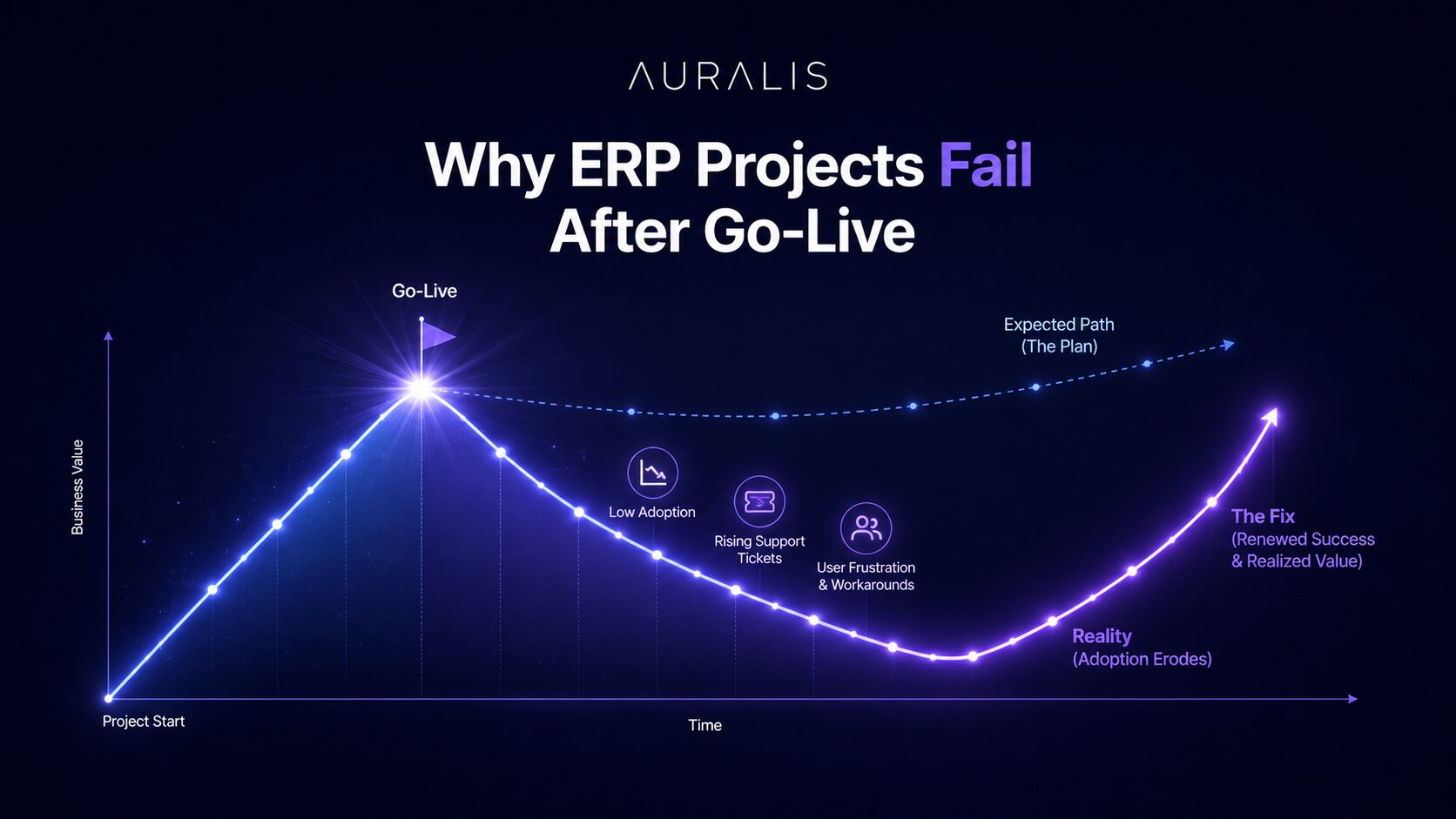
Why ERP Projects Fail After Go-Live (And How to Fix It)
ERP projects don't fail on go-live day, they fail in the months after. Most D365 F&O implementations achieve a successful cutover, but adoption gaps and support overload undo the gains.
The Complete Guide to ERP Support in 2025
How AI-powered ERP support eases post-go-live challenges, improves user adoption, reduces costs and lifts overall efficiency for your business.