Complete Guide to Knowledge Base Chatbot for Customer Support
Learn how knowledge base chatbots can help speed up your customer support process by responding to queries with intelligent integrations.
Learn about the impact of Gen AI on customer support for fast-growing and enterprise businesses and how you can get started.
As markets get more competitive, businesses are acknowledging the importance of loyal customers to drive sustainable revenue. But loyalty isn’t built in a day!
From delivering the best of products and services to ensuring a great post-purchase experience, there’s a lot that goes into ensuring customer satisfaction. And as the digital landscape grows, it’s becoming difficult for businesses to manage these relationships.
In this post, we’re going to look into how AI chatbots and workflows can help improve customer satisfaction.
Customer satisfaction is the measure of how well a business’s product or services meet the consumer’s expectations. It is often measured through product ratings, reviews, surveys, and feedback mechanisms to gather insights into the customer experience. It is also measured in the form of:
Yes, there are several channels for businesses to acquire new customers. But according to a study by HubSpot, 93% of customers are likely to make repeat purchases from companies that offer excellent customer service. And businesses that prioritize customer satisfaction, see a 4-8% increase in revenue as reported by Bain & Company.
Added to that, surveys have found that 86% of buyers are willing to pay more for a better customer experience. In fact, companies that excel in customer satisfaction also outperform their competitors by 60% despite limited products/ services to offer.
Despite its importance and benefits, businesses often struggle to ensure their customers are satisfied. Some of the common challenges are:
AI and automation are enabling businesses to handle customer conversations at scale. But here are some ways in which these technologies are making a positive impact on customer satisfaction delivered:
AI chatbots can provide round-the-clock customer support. This ensures customers get assistance whenever they need it, eliminating the frustration of waiting for business hours to resolve urgent issues.
For example, a customer wants to track the status of their online order. They can get order updates or initiate a return/ refund at midnight without having to wait for human agents to process the same.
One of the biggest pain points for customers is waiting for a response – irrespective of the channel they reach out to a business on. Chatbots can easily handle multiple queries simultaneously using AI to provide instant and contextual answers.
For example, travel companies can use AI chatbots to answer queries about the packages available, booking information, cancellations, and refunds.
AI chatbots can analyze current and past data in real-time to understand customers better. Based on data like past interactions, purchase history, preferences, and other behaviors, chatbots can trigger personalized responses that are relevant to individuals.
For example, banks can recommend the best-suited loans to a customer based on their history, available bank balance, savings, and other parameters. This helps the customer make an informed decision faster too.
With AI’s ability to process data in real time, businesses can anticipate customer needs. This helps them offer proactive support by analyzing patterns and triggers, reducing the number of support queries customers need to initiate.
For example, an internet service provider is anticipating a power outage. They can use chatbots to notify customers of the same along with steps to reboot their systems in advance.
AI chatbots can easily handle communication in multiple languages. This helps the business break down language barriers, giving them the ability to cater to a global audience.
For example, hospitals can use chatbots to assist patients with post-appointment care and important information in their native language. This helps reduce miscommunication and shows empathy towards their concerns.
Addressing customer queries and comments across channels manually can be overwhelming and often prone to inconsistencies. AI chatbots can help businesses set up multichannel support with standardized processes and responses to meet customer expectations.
For example, a business can choose to offer support via website live chat, WhatsApp, social media, or even SMS with custom chatbot workflows.
Unlike human agents, chatbots and AI co-pilots can handle an unlimited number of conversations simultaneously. This helps the business ensure consistent service quality even during peak times, improving the overall customer satisfaction rate.
For example, eCommerce businesses see a high volume of support queries during BFCM. Businesses can handle thousands of such conversations without delays, assisting shoppers and driving more sales with chatbots.
By automating routine queries, AI chatbots can free up human agents. This lets human agents focus more on complex issues, reducing operational costs without compromising on the service quality offered.
For example, a SaaS company can use chatbots to address FAQs and troubleshooting assistance. With the help of AI, they can identify complex queries or custom requests, initiating a seamless hand-off to human agents.
With natural and actively flowing customer conversation, AI chatbots can help businesses gather valuable customer data during interactions. This helps businesses get more insights into customer preferences, pain points, and behavior, which can help drive improvements in products and services.
For example, a fitness app can identify frequently asked questions about specific health regimes and diets. The company can then offer detailed guides and tutorials to the users to meet their demands.
If your business sells through multiple channels – online and offline, a good AI chatbot system will help tie customer data to create comprehensive profiles. This helps personalize every touchpoint in a consistent way and also tie in customer loyalty programs to keep them engaged in a value-first manner.
For example, a fashion brand that sells both online and offline. AI chatbots can assist them with making purchases based on previous offline interactions and share the rewards available for them to redeem online.
Delivering a great customer experience is about creating a seamless journey for your consumers – irrespective of the path they choose.
With interaction journeys becoming non-linear, AI chatbots are enabling businesses to remain agile and adapt to changing customer behavior and preferences.
Auralis AI is helping businesses create custom workflows using AI and automation to help businesses tailor customer interactions on a 1:1 basis, leading to higher engagement rates and satisfaction rates that are 5x higher than before!
To know more, book a demo.

When it comes to offering a great customer support experience, it’s not just about a good response time. Businesses that are going a step further to personalize chat experiences with localization see improved customer satisfaction rates along with faster query resolution.
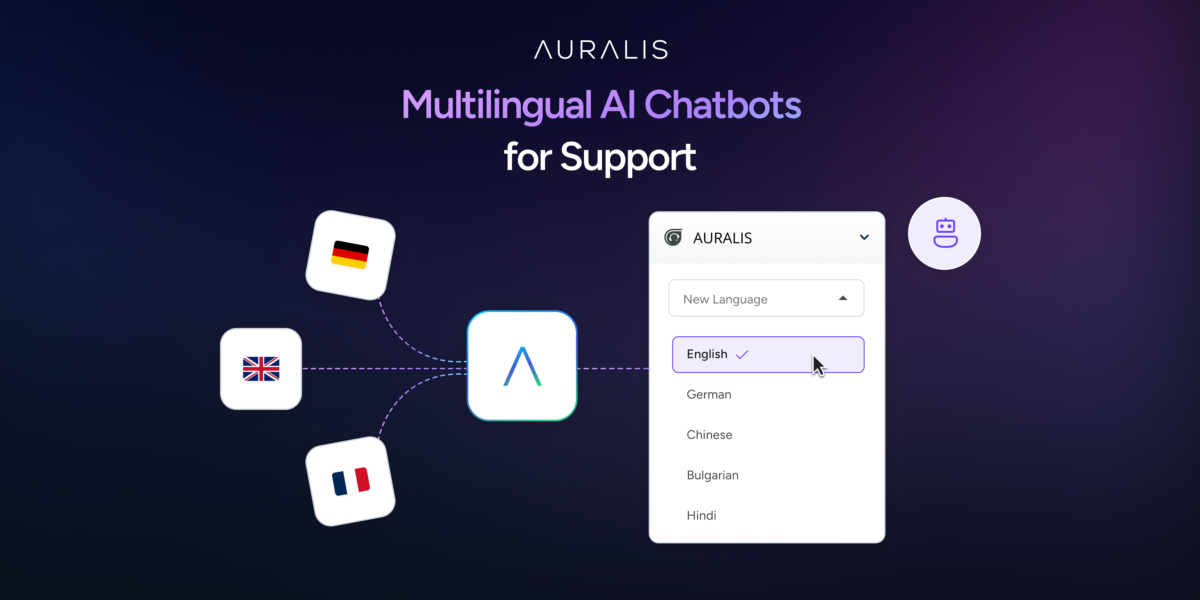
In this post, we’re going to go over what multilingual customer support is, its importance, and how AI chatbots can help.
Multilingual customer support refers to providing customer service in multiple languages. It is focused on catering to a diverse customer base to ensure they receive assistance, resolve issues, and interact with the support team in their preferred language.
Some of its benefits include:
Despite its several benefits, here’s why companies are not able to offer multilingual customer support at scale:
But the good news is that AI customer support chatbots can help you overcome these challenges.
Here’s how AI customer support solutions like Auralis help offer effective and efficient multilingual customer support:
Instead of trying to set up chatbots in different languages, we recommend leveraging AI-powered solutions like Auralis.
If you’re using Auralis AI to set up multilingual AI chatbots for customer support, you get a Done for You (DFY) Solution. We take care of all the setup and training so you can get started with customer support immediately!
But if you’re using another solution, here’s a quick checklist to set up multilingual AI chatbots for your support strategy:
As your business starts to address a global market, multi-lingual support is a must-have. By engaging customers in their preferred languages, businesses can improve customer satisfaction and expand market reach – while improving their product/ service adoption.
But offering multi-lingual support is easier said than done.
This is where Auralis AI comes in.
Learn why multichannel customer support is important for businesses and how custom AI agents along with automation can help businesses grow.
Customer expectations are evolving rapidly and the one thing that is becoming non-negotiable is proactive support and service.
But as new platforms come into play and engagement behavior changes, it’s time for businesses to re-strategize how they approach customer support and service. So in this post, we’re sharing some of the customer support and service trends for 2025 that you should be aware of!
Here are some of the trends we’re seeing competitive companies adopt using AI-powered custom workflow solutions like Auralis AI:
With customer journeys becoming non-linear, businesses must offer customer support across multiple channels. This will include email, live chat, social media, messaging apps, voice, SMS, and even video calls.
Engaging with customers on their preferred channels will help businesses drive higher participation in conversations, get a complete picture of their customers, reduce friction, and establish stronger relationships.
As businesses go global, offering localized support will become a part of their personalized efforts for specific markets. Multi-lingual support can help companies break down language barriers, show cultural sensitivity, and build stronger relationships with international customers.
Businesses can easily scale their localization efforts with the help of AI solutions that can help with real-time translation for seamless, localized interactions.
Modern customers expect businesses to understand their needs and this includes going past their ‘first name’. We will see businesses focus on running more integrated communication with their support systems to personalize conversations for every individual.
This will include leveraging integrations to access data from previous interactions, purchase history, purchase patterns, and behavior. Personalization in support will also allow businesses to create upsell and cross-sell campaigns based on 360-degree context.
Customer support has mostly been a reactive approach. But with customers expecting a better understanding of their needs from businesses, proactive customer support is what will set companies apart in competitive domains.
Proactive customer support will involve identifying and addressing problems before they escalate. This will include analyzing customer behavior data, purchase patterns, and behavior, and anticipating potential issues to work towards resolving them in advance. Predictive customer support will become more common as AI systems get integrated into business operations.
AI has been gaining popularity for helping businesses understand the intent of conversations with sentiment analysis. While this has been mostly used for marketing and advertising campaigns, we’re seeing its use increase in customer support workflows as well.
The trend would include using AI to understand the customer’s tone and mood, allowing agents to respond empathetically.
Customer support can no longer run in siloes. From marketing to product development, efficient customer support requires insight and depth from multiple departments.
2025 will be all about promoting cross-departmental collaboration and knowledge sharing. The integrated approach will give agents better access to data across teams, allowing them to provide accurate information that improves customer experience.
Customers no longer want to wait on phone calls or email reverts to get the assistance they need. With self-service becoming more popular among customers who prefer to resolve issues independently, companies will need to go beyond setting up knowledge bases, FAQs, and video tutorials.
This will include integrating solutions like AI co-pilots with self-serve support platforms to make it simpler for customers to find the solutions they need. Companies can automate responses with AI agents and co-pilots to help customers sift through information faster.
Online communities are becoming more popular by the day as an extension of self-service. These are platforms established by businesses to create a community that helps one another seek advice or find solutions to their questions.
Businesses would be able to not just improve their brand stickiness with communities but also leverage AI to extract insights that help them support their customers better.
Customer support automation will go beyond the usual chatbots and leverage conversational AI for higher relevance. This will enable business chatbots to understand more complex inquiries and respond in natural, conversational tones to keep customers engaged – moving away from the traditional rigid workflows that automation followed.
Businesses will also be able to mimic human agents with advanced NLP to give their support conversations more personality – all without needing to hire large human-agent teams.
Gen AI is finding varied use cases across departments and customer support will be no different. In 2025, we will be seeing Gen AI used to fuel customer support co-pilots.
These co-pilots will help create responses, and FAQs and even suggest personalized solutions on-demand based on conversations. This approach will help agents respond faster and streamline content creation for support while maintaining brand consistency.
While automation handle the efficiency required for customer support and service, businesses will be seen focusing on customer experiences in 2025.
With the use of AI, businesses will be able to analyze conversations better and go beyond resolution rates to understand customer sentiment, iQS CSAT scores, and other key metrics that help deliver positive experiences across touchpoints.
Customer support automation has been around for a while now. But with custom AI solutions, businesses will be seen building workflows tailored to their customer journeys.
This will mean ditching the ready-to-use templates to go beyond resolving common issues through chatbots and creating workflows that can automate almost 70% of the support with more natural conversations.
But before you build out custom workflows, we recommend auditing your customer support automation.
Yes, the status quo strategy does help businesses address customer support.
But here’s why businesses need to optimize based on changing digital interactions and customer preferences:
As customer support expectations evolve, businesses must remain agile and responsive to changing preferences. And the best way to do so is to use a support solution that stays ahead of innovation.
Auralis AI is building the next wave of automation using real intelligence that helps businesses tailor the experiences their support can deliver.
To know more, book a demo today.
AI-powered customer support automation is changing the way businesses tackle customer interactions. But what makes these tools more efficient and effective is how seamlessly they are integrated into your support processes and the access they have to information that can help them respond to queries with more context.
Now this is where customer support AI integrations come in.
In this post, we’re going to share the must-have integrations we recommend to customers at Auralis AI to set up custom AI workflows for support.
While AI customer support solutions can integrate with several tools and technologies, here are the ones that have the maximum impact on efficiency:
A good CRM is a repository of customer information including interaction history, purchase behavior, preferences, demographics, and service requests. This integration helps customer support AI agents and co-pilots access this information to understand consumers better, recommend additional products or services, and offer a more personalized interaction.
The integration can also help with seamless hand-offs to human agents. AI co-pilots can consolidate customer data from the CRM to help agents quickly catch up on context to resolve complex queries faster.
Insight: Auralis AI can be integrated with HubSpot, Pipedrive, and Salesforce CRMs.
Also read: Why and how to integrate your CRM system and AI chatbots
Integrating marketing tools with your customer support tool can help AI agents access customer engagement data and analyze their journeys with your business. This helps ensure that the support responses remain aligned with their customer journey stage, ongoing campaigns, and promotions.
AI co-pilots can also use marketing data to detect signs of customer churn and proactively run engagement campaigns – be it offering assistance, incentives, or upselling and cross-selling from other products/ services available.
Insight: Auralis AI integrates seamlessly with ActiveCampaign, Sendinblue, MailChimp, and WhatsApp.
Integration with analytics tools can help customer support AI agents improve responses based on real-time insights on behavior and trends. This also helps monitor the impact of AI-powered automation to measure business impact and identify areas of improvement.
The integration has helped Auralis AI users monitor which types of responses or resolutions are the most effective, identify common issues, and track KPIs like resolution time and customer satisfaction rate more accurately.
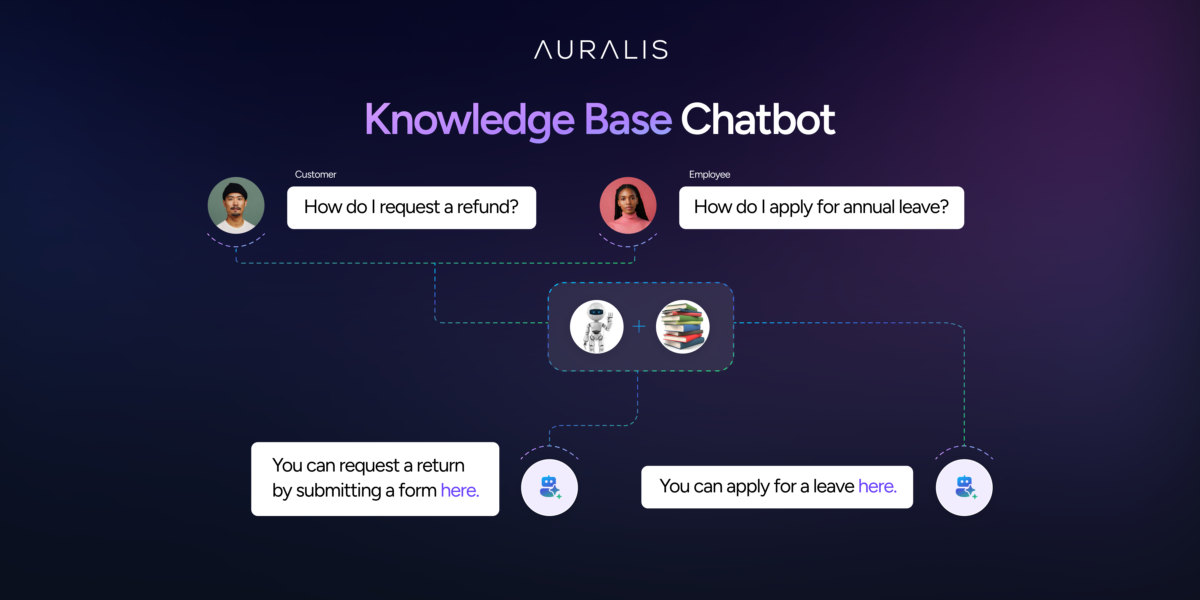
A company knowledge base serves as a repository of all business-related information across departments. This includes product details, troubleshooting guides, frequently asked questions, case studies, testimonials, how-to guides, and more.
When you integrate customer support AI agents with the knowledge base, you reduce the need for human intervention. The agents can direct customers to self-service solutions, provide detailed troubleshooting steps, and even share up-to-date information on products/ services. This can help improve first-contact resolution rates.
Insight: Auralis AI agents can integrate with Zendesk, Freshdesk, Kayako, Shopify, and Zoho Desk.
When you integrate customer support AI agents with your service desk, you get to effectively manage, route, and track requests/ queries. Service desk platforms centralize support tickets and streamline issue resolution workflows. When integrated with customer support AI agents, you can log, update, and monitor the status of requests in real-time, and also improve the workflows set up for faster resolution.
Apart from automated ticket creation and status updates, the integration can help optimize escalation triggers and create a more methodical approach to incident reporting.
Insight: Auralis AI integrates with Jira Service Desk, ServiceNow, ManageEngine ServiceDesk Plus, Gorgias, and Intercom.
While it may not feel as important or would require additional resources, here’s why these integrations are important:
For the integrations to do their job, you need to also follow a few best practices:
Also read: Best practices for implementing AI-powered customer support automation
Setting up integrations is like creating a connected workflow that helps your customer support functions align with other teams.
It helps them not just serve customers better with personalized interactions, but also understand them better to run campaigns that add value to the bottom line of the business.
Solutions like Auralis AI integrate with the best tools across all integration categories. This makes it possible for businesses to create custom support workflows and set up AI co-pilots that bring efficiency and effectiveness into every interaction!
Want to create an integrated customer support automation workflow? Book a demo of Auralis AI today.
Learn how Personalized Customer Support powered by AI can boost satisfaction, tailoring every interaction to individual needs.
Customer support automation has become a must-have for businesses across industries. Whether you’re running a small business or an enterprise, ensuring customer experiences and interactions remain proactive has become a priority for everyone.
While customer support automation tools do all the heavy lifting to keep the processes efficient and effective, we do recommend conducting regular audits.
In this post, we’re going to walk you through what customer support automation audit is, why it’s important, and its importance as your business functions scale.
An audit refers to a systematic review of all the automated customer service and support processes. This typically includes assessing the automation workflows, chatbots, responses, escalation paths, integrations, and data analysis capabilities, to ensure each has a positive impact on the customer experience.
Here are some reasons to audit your customer support automation at regular intervals:
An audit can be conducted in many different ways. But here’s a step-by-step to ensure you cover all the ground:
Start by setting a clear objective for the audit. This could be improving your response time, boosting agent productivity, increasing the accuracy of responses, or optimizing the user experience.
Next, gather the data and insights available to you around the current automation. Here are some customer support metrics to cover:
Next, categorize your support automation based on the type of query or the department that needs to handle it.
Look for redundancies, irrelevant responses, and any inconsistencies in the automation workflow. Ensure that each workflow is intuitive and the scripts being used by chatbots, AI co-pilots, and human agents are updated to reflect your brand voice and policies.
AI and automation in customer support only work well when they’re well-integrated with different customer-facing departments.
This is why you should evaluate the effectiveness of the integration with systems like your CRM, marketing automation, and analytics tools. Ensure that the data is flowing smoothly across platforms to give you a holistic view of customer interactions for accurate insights.
Also read: Why and how to integrate your CRM systems and AI chatbots
Maintaining a balance between automation and human-handled conversations is important. This is why assessing your escalation path is important.
Evaluate the queries for which a hand-off has occurred before. Evaluate the effectiveness of the process and make adjustments if issues take too long to reach an agent to resolve the query.
Customer support handles a lot of sensitive information. Assess how the automation tool is handling data to comply with laws like GDPR.
We also recommend consulting with your legal team to identify new compliances or regulations that your business needs to abide by. This helps proactively update your processes for customer data security.
Once your audit is complete, compile the findings into a clear report.
Highlight your strengths, weaknesses, and areas of improvement and loop in the concerned teams to propose specific actions that can help optimize the process for better performance. Here are some opportunities and gaps to report:
Also read: Best practices for implementing AI-powered support automation
Here’s why businesses are using solutions like Auralis AI for customer support automation and related audits:
Also read: How to leverage AI-driven insights for smarter customer interactions
Just as customer support automation is a must-have, so are the audits.
They help you not just identify loopholes in your existing systems, but also find ways to improve the workflows to make each support interaction more efficient and effective.
This is where solutions like Auralis AI come in. It offers a Quality Auditor that automatically audits every ticket and makes sure your responses remain consistent, accurate, and helpful.
Additionally, Auralis AI helps you build out custom AI automation workflows based on the insights to give you a more unique and competitive advantage.
Want to know more? Book a demo of Auralis AI today.