7 min read
 Support ticket volumes are rising fast. With digital channels multiplying, businesses are facing longer queues, higher AHT, and mounting support costs.
The irony? Most of these tickets are repetitive and straightforward, such as password resets, order updates, and refund checks. Agents spend hours giving the same answers, leading to fatigue and burnout that customers can sense.
This is where AI agents make a difference. They don’t replace human teams; they work alongside them. By automating low-impact tasks and routing only critical queries to agents, AI reduces pressure and frees teams to focus on meaningful interactions.
In this blog, we’ll break down why support burnout happens and how AI agents can help you prevent it.
What Causes Customer Support Burnout?
Here are some common reasons that lead to customer support burnout:
1. High ticket volumes and repetitive inquiries
As a company grows, it’s natural for support ticket volumes to grow alongside it, but the real problem starts when agents spend most of their time answering the same questions repeatedly.
These queries aren’t physically exhausting, but they’re mentally draining. Over time, handling high volumes of repetitive issues leaves little room for focus or creativity, causing stress to build up within support teams.
2. Pressure to meet SLAs with limited resources
SLAs exist to set clear customer expectations, ensure consistent service quality, and provide performance benchmarks. However, they become a challenge when ticket volumes rise and team size remains the same.
Support agents are pushed to meet targets with limited capacity, often leading to rushed conversations and a drop in quality. For example, if three people are expected to clear 400 tickets in a day, it’s not sustainable.
3. Emotional strain from frustrated customers
Not every customer is calm and patient. Many reach out frustrated, upset, or with unrealistic expectations, like demanding an immediate refund for an item still in transit or expecting a complex issue to be fixed within minutes.
Handling these emotionally charged conversations repeatedly requires patience and empathy, which can be draining for support teams.
4. Lack of effective tools and context
Many teams still work with fragmented systems. Without proper tools, agents waste valuable time switching between dashboards, searching for past interactions, or manually piecing together customer histories. This lack of context slows them down, creates unnecessary friction, and makes even simple tasks feel more difficult than they should be.
The Business Impact of Burnout
Here are some business impacts of support team burnout:
1. Increased agent turnover and hiring costs
Burnout is one of the leading causes of agent attrition in the support industry. Replacing a single entry-level agent costs around 30–50% of their annual salary, and even more in the case of senior employees.
High turnover disrupts workflows, slows down response times, increases hiring and training costs, and places extra workload on remaining team members, creating a cascading effect that’s hard to break.
2. Declining CSAT and NPS scores
Burned-out agents struggle to maintain the same quality of interactions. They’re more likely to provide rushed responses, show less empathy, and make more mistakes. This directly impacts customer satisfaction (CSAT) and loyalty (NPS) scores. Over time, this decline damages customer trust, increases churn, and can even affect revenue growth.
3. SLA breaches and slower resolution times
When teams are stretched thin, maintaining response and resolution targets becomes a challenge. Burnout leads to slower handling times and missed SLAs.
Longer queues frustrate customers, escalate complaints, and increase the pressure on already overworked agents, creating a vicious cycle that negatively impacts performance and the customer experience.
4. Hidden costs of disengaged employees
Burnout doesn’t always result in immediate resignations. Often, employees stay but disengage. Disengaged employees work slowly, make more errors, and are absent more often.
Globally, low engagement costs businesses an estimated $8.8 trillion in lost productivity, around 9% of GDP. At the team level, this shows up as reduced efficiency, inconsistent support quality, and quietly rising operational costs.
How AI Agents Prevent Burnout in Support Teams
Here’s how AI agents can help you prevent burnout in support teams:
1. Automate FAQs and repetitive queries
A large portion of support tickets involves simple, recurring questions, like order status, delivery updates, password resets, or basic troubleshooting.
AI agents can resolve these instantly and accurately without involving human teams. By automating repetitive work, they reduce cognitive load and prevent the mental fatigue that comes from answering the same questions hundreds of times a week.
2. Triage tickets to reduce overload
AI agents can read incoming messages, identify the issue type, and route tickets to the right place, whether that’s self-service, bots, a specialized team, or a priority queue.
For example:
- A customer writes, “My shipment hasn’t moved in a week.”
- The AI detects it’s a logistics-related issue and routes it directly to the shipping team.
- Simpler questions, like “Where’s my order?”, are handled automatically by the bot.
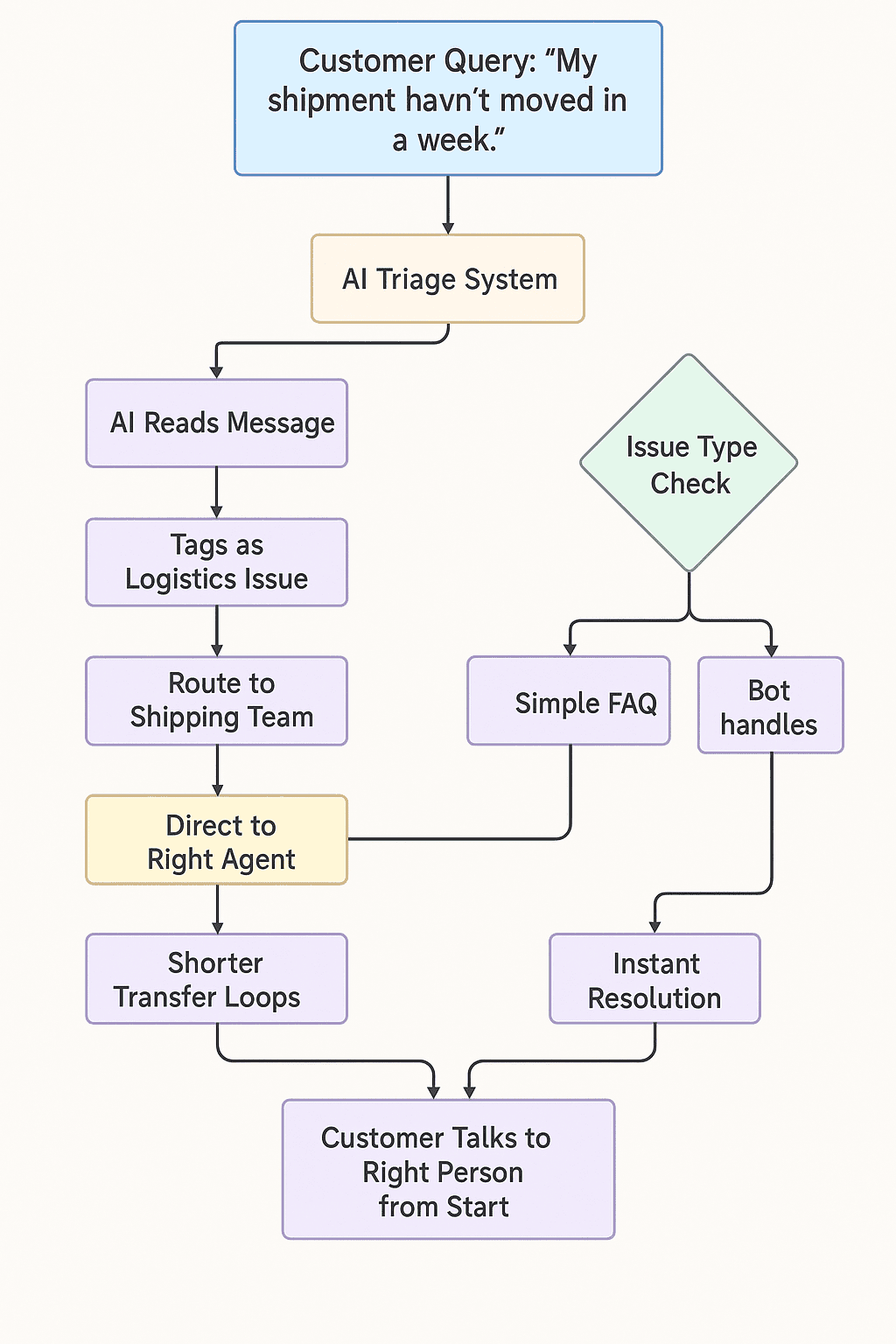
This reduces transfer loops, shortens resolution times, and ensures customers are directed to the right team from the start. It keeps queues organized and prevents agents from being overwhelmed by misrouted tickets.
3. Provide contextual knowledge suggestions for faster answers
AI-powered tools can surface relevant articles, past ticket histories, or step-by-step instructions as agents work. Instead of switching between tabs or digging through databases, agents get the right information instantly.
For example, during a live e-commerce support chat, the AI might suggest:
- A pre-approved response for delayed shipments
- A direct link to the customer’s order tracking page
- A step-by-step process to initiate a return
This real-time assistance helps agents respond faster and with greater accuracy, cutting average handle time and allowing them to resolve more tickets without feeling rushed.
4. Enable 24/7 coverage without stretching human teams
AI agents can provide instant support around the clock, handling routine queries outside business hours and escalating only when necessary. This ensures customers get timely responses while human teams aren’t stretched into late nights or constant on-call cycles, significantly reducing stress and burnout.
5. Sentiment analysis for prioritizing escalations
AI can detect tone and urgency in real time. If a customer writes, “This is the third time I’m reaching out!”, the system flags it as high priority and pushes it up the queue.
Since 79% of customers expect faster responses when upset, this kind of prioritization improves CSAT while reducing unnecessary escalations. It ensures agents focus their energy where it matters most.
How Auralis Helps Support Teams Stay Productive
Auralis is a customer support AI platform designed to lighten the load on human agents. It integrates with your helpdesk and knowledge systems, learns from your data, and automates the repetitive parts of support.
Here’s what Auralis brings to the table:

- Helpdesk Assistant: Auralis acts as a smart layer within the helpdesk, offering real-time reply suggestions, relevant macros, and recommended next steps. This streamlines responses, reduces manual typing, and helps agents maintain accuracy and speed, especially during high ticket volumes.
- Live Chat AI Agent: For common questions like order tracking, password resets, or basic troubleshooting, the Live Chat AI Agent steps in to resolve them instantly. By managing these repetitive interactions end-to-end, it keeps backlogs low and frees agents to handle more complex issues that require human judgment.
- CX Coach: Auralis includes a built-in CX Coach that accelerates onboarding. It guides new agents in real time, surfaces relevant information, and reduces the dependency on senior team members for every small question. This shortens ramp-up time and eases training pressure on the team.
- Proven outcomes: With Auralis in place, teams resolve 60% of tickets automatically and save 15+ hours per agent each week. Leading to fewer repetitive tasks, faster resolutions, and more focus on meaningful customer interactions without increasing headcount.
Conclusion
Support burnout impacts costs, customer satisfaction, and overall business performance. As ticket volumes rise and expectations grow, traditional support models simply can’t keep up.
AI agents change that. By automating routine work, triaging intelligently, and supporting agents in real-time, they ease the pressure on teams and improve the customer experience simultaneously.
Auralis makes this shift simple. It plugs into your existing stack, handles the repetitive, and helps your team focus on what really matters, resolving complex issues with speed and empathy.